
Elementor statistics in 2026 show just how far the builder has evolved from a simple drag-and-drop plugin into one of the most influential products in the WordPress ecosystem. Today, Elementor sits at the center of conversations about no-code site creation, agency workflows, AI-powered design, and the future of page building on the open web.
Elementor has officially entered its second decade. In just 10 years, it has grown from a page builder into one of the most influential forces in WordPress, powering millions of websites worldwide. The scale Elementor has reached makes its 2026 statistics more than just numbers—they tell the story of a platform that continues to shape the future of web creation.

What makes this report especially important is that different sources measure Elementor in different ways. WordPress reports plugin installs and ratings, Elementor’s own pages highlight total websites built and AI adoption, and secondary industry roundups.
In this blog, you will get the clearest 2026 picture possible: Elementor market share, Elementor website statistics, ecosystem data, business insights, competitive context, and what the next phase of growth may look like.
TL;DR: Quick Summary
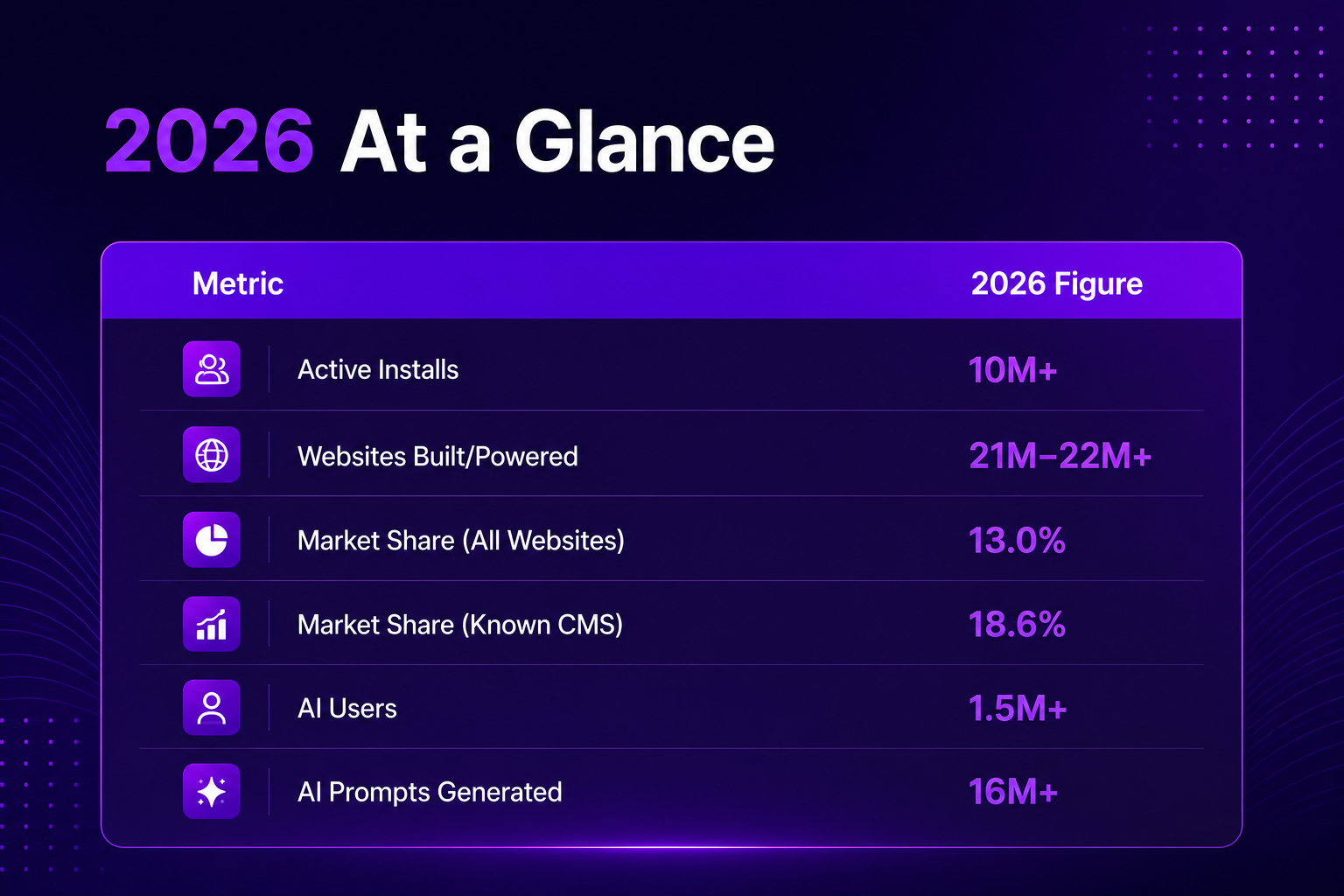
Before diving into the deeper analysis, it helps to anchor the conversation in the numbers that matter most. These headline Elementor stats give you the fastest possible read on scale, adoption, and momentum. A decade in, Elementor has grown from a 2016 page builder launch into a platform that now powers 13% of all websites worldwide. They also set up the bigger questions this article answers next, from market share to performance to future growth. If you only need the short version of the statistics on Elementor, start here.
- Elementor is used by 18.6% of websites whose CMS is known, equal to 13.0% of all websites tracked by W3Techs as of June 11, 2026.
- Elementor’s official homepage says it is used on 13% of sites worldwide and has helped build 21M+ websites.
- The plugin API reports 10,000,000 active installs, a 90/100 rating, and 7,259 ratings for Elementor.
- Elementor’s plugin description claims it is powering 21M+ websites worldwide, showing how official “websites built” and “websites powered” figures can differ by methodology.
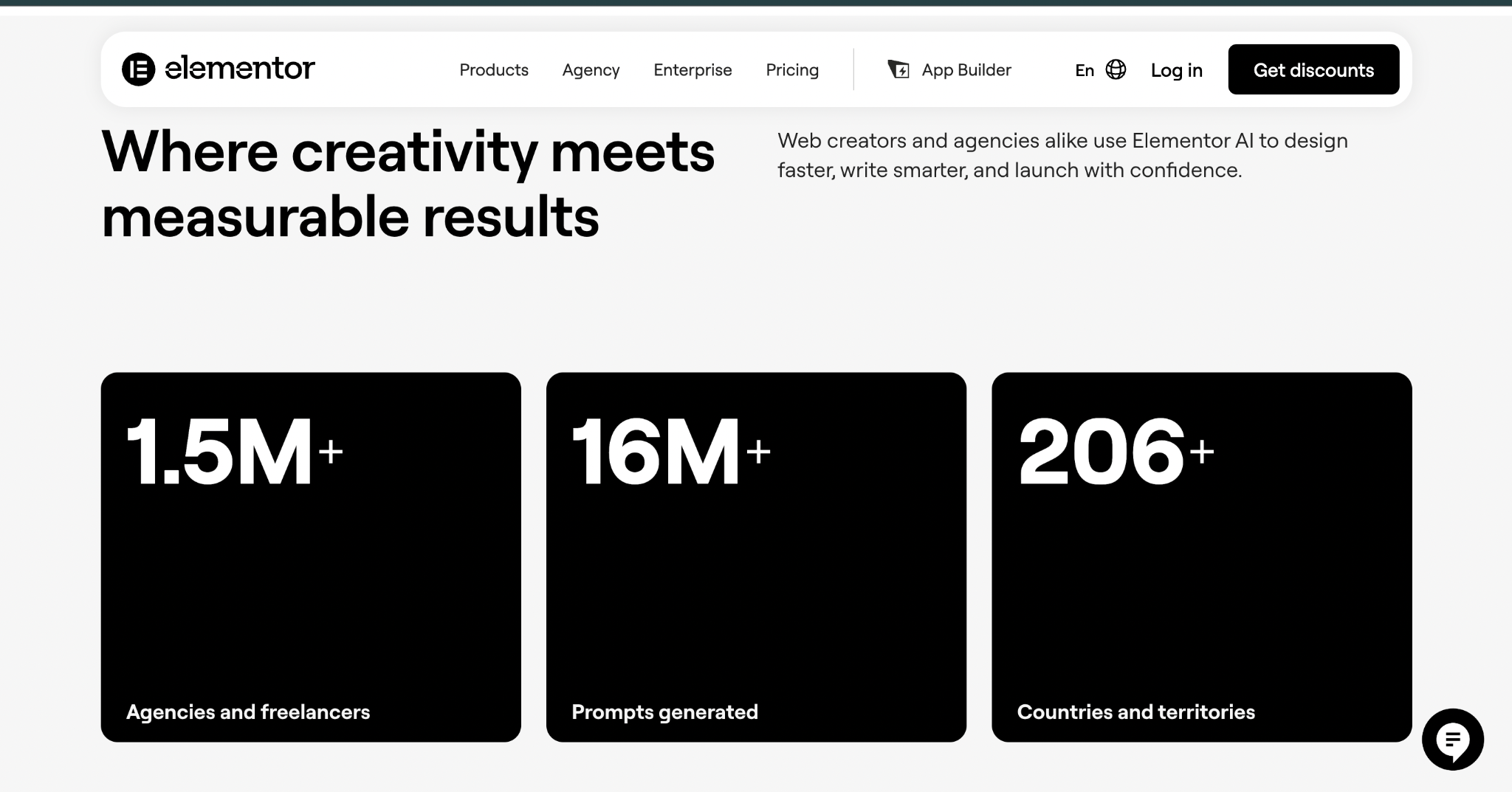
- Elementor AI says it is trusted by 1.5M+ agencies and freelancers, has generated 16M+ prompts, and is used across 206+ countries and territories.
- Essential Addons for Elementor alone reports 2,000,000 active installs, 110+ widgets, and 3,000+ ready templates, underscoring how large the addon ecosystem has become.
- A secondary industry roundup from Colorlib estimates Elementor still controls roughly 40% to 50% of the page builder market, though it says the share has eased from a 2023 peak of 56%.
- Elementor remains far ahead of other tracked builder brands on W3Techs, where Divi Builder is below 0.1% of all websites, Bricks is at 0.1%, and Beaver Builder is at 0.4%.
Why Elementor Became So Popular
Those headline numbers make more sense once you look at the product decisions that drove adoption in the first place. Elementor did not become a giant by accident; it grew because it solved practical WordPress pain points faster than many alternatives. It lowered the barrier to design while still giving agencies and advanced users room to scale. That combination of accessibility and flexibility is the reason Elementor statistics stayed so strong into 2026.
Visual Drag-And-Drop Editing
Elementor’s biggest breakthrough was making WordPress page creation feel visual instead of technical. Its plugin listing still centers the product around no-code drag-and-drop editing, layout control, responsive design, design systems and reusable components, all of which helped non-developers build pages that once required custom theme work.
No-Code Website Creation
The rise of Elementor also maps directly to the rise of no-code. Elementor’s own positioning in 2026 emphasizes creating, optimizing, and managing websites without sacrificing design freedom, while its Site Planner promises to turn ideas into sitemaps and wireframes in seconds. That shortens the journey from concept to launch, which is exactly what freelancers, small businesses, and marketing teams want.
Large Template Ecosystem

Template libraries helped Elementor scale far beyond expert users. Its WordPress plugin description highlights complete website kits, pages, blocks and popup templates, while the wider ecosystem built around Elementor keeps expanding the number of starting points available to users. That matters because templates reduce both project time and design risk.
Third-party Addon Ecosystem

A big part of Elementor’s long-term adoption comes from its broader plugin and template ecosystem. Beyond the core builder, users can extend Elementor with a large library of third-party addons, widgets, templates and site kits built for different use cases, industries and workflows. That ecosystem makes Elementor more flexible for agencies, freelancers, store owners, and marketers who want extra functionality without rebuilding everything from scratch.
Essential Addons for Elementor is one example of that trend, offering 110+ advanced widgets, 3,000+ ready templates, and 2M+ active installs. Together, these ecosystem layers help explain why many users are not only adopting a page builder but investing in a wider WordPress design stack.
Track Elementor Market Share Statistics
Popularity is one thing, but market share is what turns a useful tool into an industry force. Once a builder starts showing up across millions of live sites, agencies, plugin makers and hosting providers begin building around it, from Elementor’s own hosting to managed WordPress platforms like xCloud. That network effect is exactly why Elementor’s market share matters in 2026. It reveals not only how many people use Elementor, but how much influence it has over the direction of WordPress itself.
Elementor Market Share in 2026
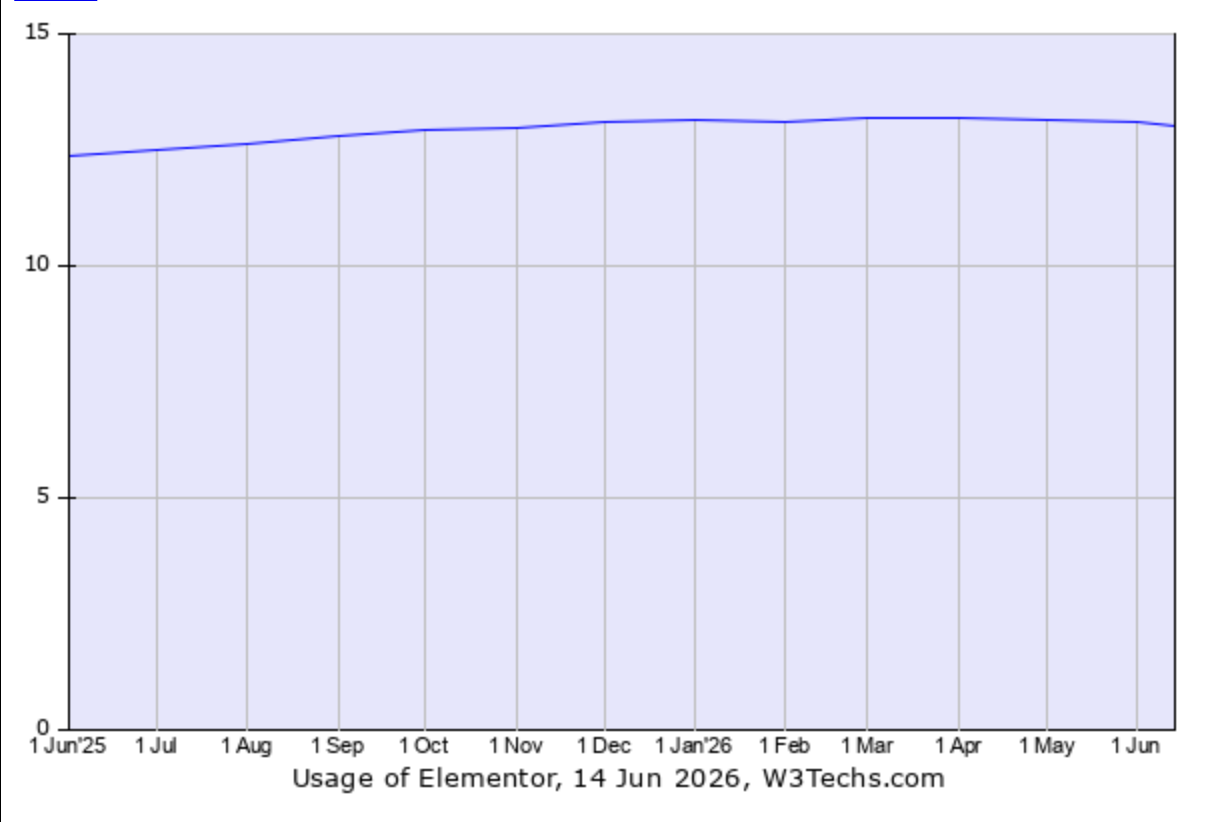
The cleanest third-party number for live web usage comes from W3Techs, which says Elementor is used by 18.6% of websites whose CMS is known and 13.0% of all websites. Elementor’s own homepage broadly reinforces that result by saying it powers 13% of sites worldwide.
Here is the simplest way to read those numbers:
| Market share metric | 2026 figure | What it means |
| Share of all websites | 13.0% | Elementor appears on a very large portion of the public web |
| Share of websites with known CMS | 18.6% | Elementor is even stronger when measured only inside identifiable CMS-powered sites |
| Official homepage claim | 13% of sites worldwide | Elementor’s own marketing broadly aligns with W3Techs |
| Estimated page builder market share | 40%–50% | Secondary estimate, useful directionally, but not as clean as W3Techs live-web measurement |
Share Among Page Builders
For live web visibility, Elementor’s gap over other well-known builder brands remains significant. W3Techs lists Beaver Builder at 0.4% of all websites, Bricks at 0.1% and Divi Builder at less than 0.1%, which makes Elementor the clear leader among individually tracked builder names on the live web.

Source: W3Techs
Comparison of Elementor vs WordPress Market Share
Now that the raw Elementor numbers are clear, the next logical step is to place them inside the larger WordPress universe. That matters because Elementor does not compete against the whole internet in the same way it competes inside WordPress. Its true strategic position becomes clearer when you compare Elementor adoption to WordPress adoption directly. This is where Elementor website statistics become especially useful for agencies and SaaS teams evaluating stack choices.
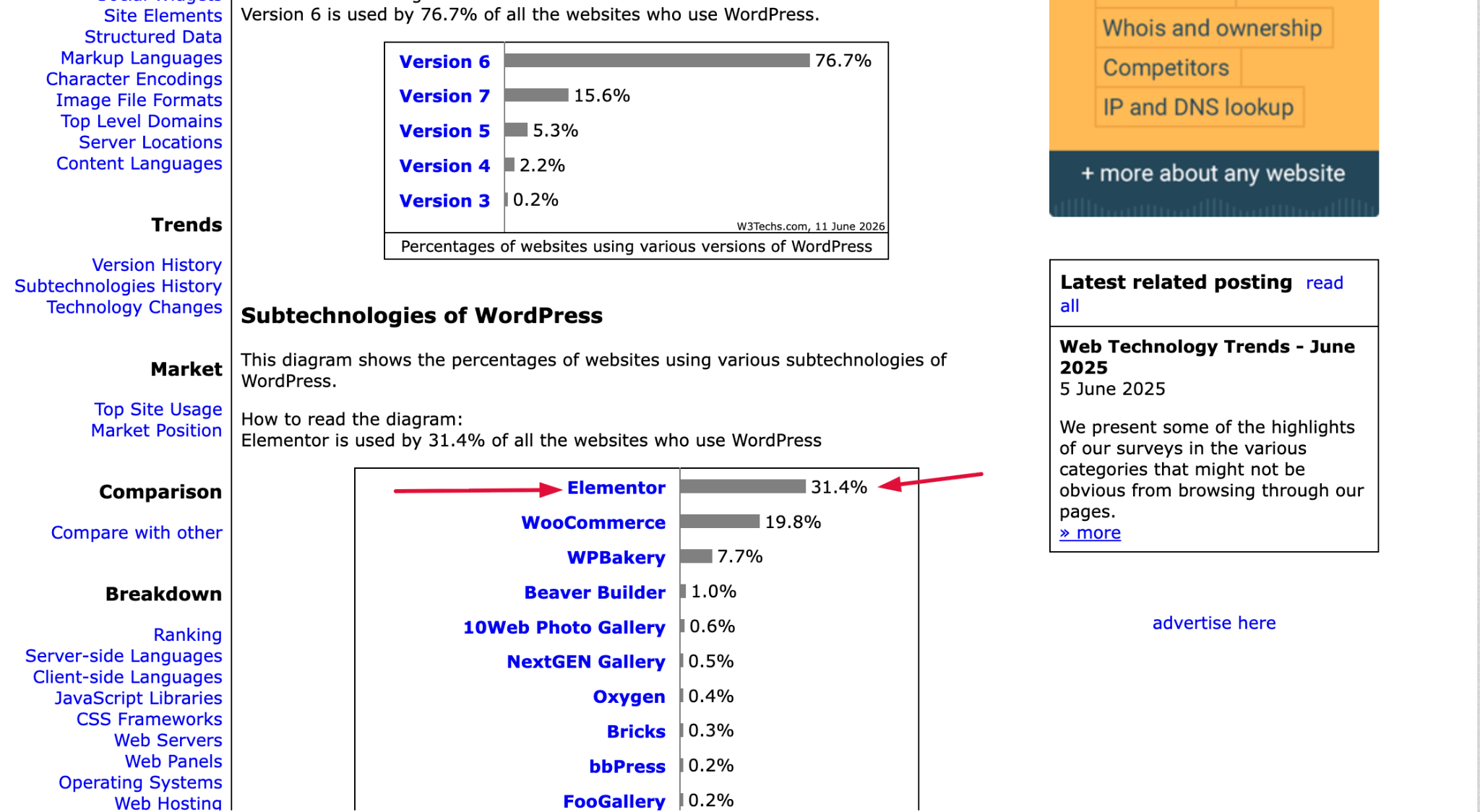
W3Techs reports that WordPress powers 41.5% of websites, while Elementor powers 13.0%. Elementor appears on roughly 31.4% of WordPress-powered websites as a directional estimate, which is an extraordinary penetration rate for a third-party builder.
That relationship also explains why Elementor remains so influential even as WordPress core continues to evolve. WordPress’s own full-site editing allows the ability to design the entire site with blocks, including headers, footers, and templates. In other words, WordPress is moving toward more native design control, but Elementor still owns a very large installed base inside that ecosystem today.
Follow Elementor Market Share Growth Over the Years
Seeing Elementor’s current position is useful, but understanding how it got there is even more valuable. Growth history shows whether a platform is still accelerating, stabilizing, or starting to mature. It also helps explain why certain trends, like AI or performance-first builders, matter more now than they did a few years ago. In Elementor’s case, the growth story is one of rapid expansion followed by a more competitive consolidation phase.
Historical Growth Timeline
Elementor’s growth story spans nearly a full decade, beginning with its 2016 launch and accelerating through the late 2010s as its addon and template ecosystem expanded alongside the core builder. By the early 2020s, Elementor had moved beyond being just a page builder and started positioning itself as a broader WordPress website creation platform.
- 2016: Elementor was added to WordPress.org on May 30, 2016, marking the start of its public plugin era.
- 2017: The ecosystem around Elementor was already expanding; The first wave of third-party add-ons (like Essential Addons) arrived by early 2017. The ecosystem experienced explosive growth between 2018 and 2020 as Elementor surpassed one million active sites and added robust API support for developers.
- 2023: Colorlib says Elementor’s page-builder share peaked around 56%, and Elementor AI began becoming a core part of the product story.
Major milestones from launch to 2026
A key 2026 milestone is not just scale but product breadth. Elementor now presents itself as a platform for creation, optimization and management, with AI, hosting, domains, accessibility, image optimization, email deliverability, and enterprise support sitting alongside the builder itself. That expansion shows the company is no longer trying to win only the “page builder” category; it is trying to own more of the WordPress website lifecycle.
Review Elementor Website Statistics
Once growth is established, the next question is scale in practical terms. How many sites actually use Elementor, what kinds of sites are they, and which public brands help validate its reach? That is where Elementor website statistics become more tangible. Instead of talking about abstract percentages, this section brings those numbers back to real websites, real traffic, and real use cases.
How Many Websites Use Elementor?
If you want the most conservative and verifiable baseline, use 10M+ active installs from WordPress and 13.0% of all websites. If you want the broader official footprint, Elementor’s homepage says 21M+ websites built, while its plugin description says 21M+ websites worldwide. Those figures are not necessarily contradictory; they are counting different things, which is why serious reporting should distinguish between active installs, live-web share, and lifetime build totals.

Elementor Adoption by Website Type
Public data does not give a perfect numeric split by site type, but the available evidence strongly suggests Elementor is most common on business sites, landing pages, marketing sites, agencies, portfolios and WooCommerce-driven stores. Elementor emphasizes theme building, popup building, forms, dynamic content and WooCommerce Builder, while Elementor’s homepage leans heavily into agency workflows and enterprise site management. That combination makes Elementor especially attractive for commercial websites where design control and handoff speed matter more than fully custom engineering.
Break Down Elementor Usage Statistics
Perhaps the strongest evidence of Elementor’s decade-long influence is the ecosystem that formed around it. What started as a page builder has grown into a much broader WordPress design economy, with plugin developers, template libraries, addon companies, educators and service providers building around Elementor as a platform. In many ways, these usage statistics do more than show adoption; they show the industry Elementor helped create. That is why plugin data, ratings, addon growth and AI usage matter so much here: they reveal the depth of the ecosystem, not just the size of the user base.
Elementor User And Adoption Statistics
Elementor AI adds a layer of user-base evidence. The company says its AI tools are trusted by 1.5M+ professionals, have powered 16M+ prompts, and are used across 206+ countries and territories. Those are not classic plugin-install metrics, but they do show how far Elementor’s reach now extends beyond “just” page creation.
Source: W3Tech
Elementor Plugin Statistics
Elementor’s plugin signals strong platform maturity: 10M active installs, 7,259 ratings. Even if you translate that more loosely into consumer-friendly language, it still points to one of the most widely trusted plugins in WordPress history.
A broader look at the addon layer shows that Elementor’s ecosystem is supported by several large companion plugins, not just one standout example. Essential Addons for Elementor reports 2M+ active installs, 4,075 ratings and a library of 110+ widgets plus 3,000+ ready templates.
ElementsKit adds another major footprint with 1M+ active installs, 2,017 ratings, a 98/100 rating, and a toolkit built around 100+ widgets, 20+ modules, and 1,000+ templates/sections.
Premium Addons for Elementor contributes 700K+ active installs, 1,671 ratings, a 98/100 rating, and 90+ widgets with more than 550 templates.
Happy Addons for Elementor is another meaningful player, with 400K+ active installs, 486 ratings, a 96/100 rating, 143+ widgets, and hundreds of template blocks.
Elementor Ecosystem And Addon Market Statistics
Elementor’s ecosystem in 2026 is broader than widgets and templates. The company now bundles or promotes AI creation, hosting, domains, email deliverability, accessibility tooling, image optimization, and agency/enterprise workflows, which means the brand is moving closer to a full WordPress operating layer.
Explore Elementor Industry Insights
Once usage is clear, the next question is where that usage shows up most often. A decade ago, Elementor primarily appealed to freelancers and small businesses. Today, its customer footprint spans agencies, publishers, eCommerce brands, educational institutions, and enterprise organizations. Elementor’s broad appeal comes from being able to serve several of those needs at once. That is why its industry reach is wider than many niche builders.
Which Industries Use Elementor the Most?
Public sources do not provide a perfect industry percentage breakdown, but the site examples and product messaging point to strong use across agencies, ecommerce, education, media, finance, and public sector organizations. W3Techs’ example list includes ecommerce and marketplace exposure through Coupang, real estate via Redfin, banking through Banco de Venezuela, and education/public-sector use through DepEd.
It explicitly markets to agencies, highlights scalable client workflows, and showcases brand recognition from media and enterprise names like CNN, Disney, Rolling Stone, National Geographic and Billboard. That suggests Elementor’s strongest verticals are likely agencies, SaaS and marketing teams, ecommerce operations, publishers, nonprofits, and creator-led personal brands.
A reasonable 2026 read is this: Elementor’s sweet spot is not one single industry, but any environment where stakeholders need fast iteration, polished front-end control, and a manageable handoff model. That includes agency client sites, marketing-led landing pages, creator businesses, digital publishers, nonprofit storytelling sites, course or education sites, and WooCommerce storefronts.
See Why Businesses Choose Elementor
Knowing where Elementor is used naturally leads to the next question: why do businesses keep choosing it? The answer is not just “it is popular.” Businesses adopt Elementor because it compresses design time, reduces dependency on custom code for many projects, and makes website ownership easier for non-technical teams after launch. Those operational advantages explain a lot of Elementor’s staying power.
Faster Development
Elementor’s Site Planner says it can turn ideas into sitemaps and wireframes in seconds, while Elementor AI says it can generate layouts, text, code, and images directly inside the editor. Together, those capabilities reduce time spent on project setup, content drafting, and layout scaffolding. That is exactly the sort of speed advantage that appeals to agencies and in-house teams alike.
Lower Development Costs
Not every project needs a custom theme or a bespoke front-end engineering cycle. Elementor’s no-code editing, template kits, theme builder, forms, popup builder and WooCommerce tooling let teams ship polished sites without writing everything from scratch. That lowers the total cost for many marketing websites and SMB builds.
Easier Client Handoff
Elementor increasingly focuses on collaboration, reusable components and agency-friendly workflows. Its homepage talks about streamlined feedback and scaling without chaos, while the plugin description highlights reusable components and controlled content editing. Those features matter because they help agencies deliver sites that clients can actually manage.
Extensive Integrations And Platform Breadth
Businesses also choose Elementor because the product is expanding beyond design. Hosting, domains, accessibility, email deliverability, image optimization, and AI tools create a more integrated workflow than a standalone builder plugin can offer. In competitive software categories, that kind of platform breadth often becomes a deciding factor.
Compare Elementor vs Other Page Builders
Once the business case is clear, comparison becomes unavoidable. Most buyers are not choosing between Elementor and “nothing”; they are choosing between Elementor and Gutenberg, Divi, WPBakery, Bricks, or a completely different site-building philosophy. That makes direct comparison one of the most useful parts of any Elementor Statistics 2026 report. The table below keeps all major comparisons in one place, just as requested.
| Builder | 2026 adoption signal | Strengths | Weaknesses | 2026 direction |
| Elementor | 13.0% of all websites; 18.6% of CMS-known sites; 10M+ active installs | Visual editing, huge ecosystem, strong agency workflows, AI expansion | Heavier performance footprint, more optimization required | Still the clear leader, but under pressure |
| Gutenberg / Site Editor | Native to WordPress core; not directly comparable as a standalone live-web builder brand | Free, native, improving full-site editing, block-based future | Less polished for some advanced workflows, ecosystem fragmentation | Fastest structural threat inside WordPress |
| Divi Builder | <0.1% of all websites; 0.1% of CMS-known sites | Loyal user base, visual editing, strong brand | Smaller live-web footprint than Elementor | Stable, but far behind Elementor on live web |
| WPBakery | Secondary estimate: 4.5M+ installs and 15%–18% page-builder share | Legacy installed base, familiar to many agencies | Aging reputation, less momentum in new builds | Still relevant, but generally seen as legacy |
| Bricks Builder | 0.1% of all websites; 0.2% of CMS-known sites | Cleaner output, performance-first reputation, strong developer appeal | Smaller ecosystem and lower mainstream reach | Fast-growing challenger |
| Beaver Builder | 0.4% of all websites; 0.6% of CMS-known sites | Stable, agency-friendly, dependable | Less momentum than newer challengers | Mature but not dominant |
Source: W3Techs
A few caveats matter here. Gutenberg is built into WordPress, so it is not measured exactly the same way as Elementor on W3Techs, and WPBakery figures are less transparent in live-web tracking, so the Colorlib estimates are best treated as directional rather than audited. Even with those caveats, the overall 2026 picture is clear: Elementor still leads, Gutenberg is the structural long-term threat, and Bricks is the performance-led challenger getting the most buzz.
Evaluate Elementor Performance Statistics
After market share, performance is the issue that defines the modern Elementor debate. A builder can dominate adoption and still face serious criticism if sites built with it are harder to optimize. That is exactly what has happened in 2026. Elementor’s performance story is now a contest between product improvements on one side and long-running concerns about bloat on the other.
How Elementor Performs in 2026
Elementor’s official homepage says it improves Core Web Vitals and search performance through adaptive loading, responsive assets, and built-in speed enhancements. Its plugin description also introduces version 4 as an “Atomic Editor” built around performance-first building blocks and reusable systems. That shows performance has become a headline priority for the brand itself, not just a side note.
Common Performance Challenges
The criticism has not disappeared, though. Colorlib says a typical Elementor page can contain 1,500 to 3,000 DOM elements, average around 3.2 MB in page weight, and show a 25% to 35% Core Web Vitals pass rate, versus lighter numbers for Bricks and Gutenberg. These are secondary benchmark estimates rather than official Elementor measurements, but they reflect the central complaint: Elementor often needs more optimization work to perform like a leaner stack. Lab scores can also flatter a site: in an xSpeed Cache study of WordPress scan data, 40 of the 89 sites graded clean on speed were still failing Google’s Core Web Vitals on real-user data.
Community Perspectives on Elementor Performance
Community discussion reinforces that point. Reddit threads describe Elementor as “a 2016 page builder running on a 2026 web,” with criticism centered on editor heaviness, code output, and the belief that complex projects increasingly lean toward Bricks or more native WordPress options. At the same time, other Reddit discussions show users still choosing Elementor because it remains easier to use and because Editor v4 looks promising. The 2026 community consensus is less “Elementor is dead” and more “Elementor must keep improving performance to defend its lead.”
Elementor Design Trends And Product Direction in 2026
Performance explains the pressure Elementor faces, but design trends explain where it can still win. Builders that simplify the future of design tend to survive even when they face technical criticism. In 2026, Elementor is trying to do that with AI, smarter layout systems, and workflow automation. Those moves align with broader web design trends rather than fighting them.
AI-powered Website Building
Elementor AI now covers layout generation, image creation and refinement, code generation, and content workflows directly in the editor. The company says users have already generated 16M+ prompts, and its Site Planner promises instant sitemaps and wireframes. That positions AI as one of Elementor’s biggest growth levers beyond standard page building.
Container-based Design
A major product trend is the move toward more flexible, system-based layouts. Elementor AI explicitly promotes AI container layouts, and Elementor’s version 4 messaging emphasizes atomic building blocks, reusable design systems, variables, and classes. That suggests Elementor is moving away from older, heavier layout habits toward more scalable design architecture.
Modern Web Design Trends
Elementor still leans heavily into features that support modern front-end design: motion effects, headline effects, masks, transforms, dynamic content, popups, and interactive layouts. In practical terms, that means Elementor remains well-suited to minimalist marketing pages, animated landing pages, creator websites, and design-driven business sites.
Accessibility And User Experience Trends
Another notable 2026 shift is that Elementor is talking more openly about accessibility and user experience as product pillars. Its homepage highlights accessibility tools that identify issues and guide improvements with AI, alongside mobile responsiveness, image optimization, and performance enhancements. That is a smart move because accessibility is becoming less of a “nice to have” and more of a selection criterion.
Understand Elementor Business And Revenue Insights
At this point, the product and adoption picture is clear, so the business picture comes into focus next. Elementor is no longer behaving like a single-plugin company. Its strategy now looks more like a platform business expanding revenue per customer through adjacent services. That shift matters because it changes how future growth should be evaluated.
Elementor’s Business Growth
Elementor’s homepage and product pages show clear product expansion beyond the builder itself. The company is now actively selling AI, hosting, domains, email deliverability, accessibility, optimization tooling, and enterprise support, which means growth is increasingly tied to platform breadth rather than plugin installs alone.
Premium Market Trends
Public, company-confirmed Pro subscription totals were not surfaced in the sources reviewed here, but Colorlib estimates 2M to 3M Elementor Pro sites and $120M to $180M in ARR. Those figures should be treated as informed estimates, not audited company financials, but they still point to a large and durable premium business surrounding Elementor.
Agency And Freelancer Adoption
The strongest official business signal comes from Elementor AI, which says it is trusted by 1.5M+ agencies and freelancers. Elementor Hosting also positions itself around agency workflows, promising performance, security, support, and management simplicity. In plain English, Elementor is clearly betting that agencies and multi-site professionals remain its most defensible commercial audience.
Weigh the Challenges Facing Elementor in 2026
Strong growth stories are only useful if they also acknowledge what could slow them down. Elementor still leads, but leadership in software is never permanent. Competitive pressure, user expectations, and WordPress core evolution are all reshaping the market around it. That makes 2026 less of a victory lap and more of a strategic crossroads.
Growing Competition
The biggest structural threat is native WordPress editing. WordPress describes the Site Editor as a way to design the full site with blocks, while Colorlib says Gutenberg FSE is growing 145% year over year. Outside WordPress core, Bricks is winning attention from performance-focused developers, and Webflow/Framer continue raising expectations for faster, cleaner, design-led workflows.
Performance Expectations
The market is less forgiving about page-builder overhead than it was a few years ago. If buyers believe a builder creates too much DOM depth, too much CSS, or too much JavaScript, they start testing alternatives even if they still like the editor experience. That is why performance has become Elementor’s most persistent reputational challenge.
Market Share Shifts
The best way to interpret Elementor’s 2026 position is not “collapse” but “maturation under pressure.” Colorlib says Elementor’s builder-market share has slipped from a 2023 peak, even while the platform remains number one by a wide margin. That usually means the category is getting smarter, not that the leader has stopped mattering.
Predict the Future of Elementor Beyond 2026
What matters now is not just how Elementor responds to today’s pressure, but how it positions itself for the next decade of web creation. Its future will likely depend on whether it can evolve from a dominant page builder into a broader platform for designing, managing, and scaling websites.
In many ways, Elementor already seems to be moving in that direction, with more emphasis on AI, hosting, workflows and platform-level tools. The bigger question is whether that long-term shift will be enough to keep Elementor at the center of WordPress in the years ahead.
Expected growth areas
The clearest growth areas are AI website creation, workflow automation, and cloud-based site management. Elementor is already pushing AI-generated layouts, code, images, and planning, while its hosting and management stack aims to cover more of the post-launch lifecycle. That makes future growth likely to come from platform integration rather than simple install-count expansion.
Potential challenges
The biggest risk is that WordPress core keeps getting better at the exact things Elementor historically sold as a premium convenience: site-wide visual editing, reusable patterns, and block-based layouts. If native WordPress improves faster while performance-focused competitors like Bricks keep winning developer mindshare, Elementor will need to prove its extra layer is worth the extra complexity.
Expert outlook
The most realistic forecast is that Elementor remains a major force through 2027 and beyond, but with a different identity. Instead of dominating purely through visual editing, it is likely to compete through AI assistance, agency productivity, platform breadth and managed WordPress workflows. If it can combine those strengths with measurable performance gains, its lead can remain durable; if not, its share may continue to fragment slowly.
Turn These Elementor Insights Into Action
The biggest takeaway from these statistics on Elementor is simple: Elementor is still the benchmark WordPress builder in 2026, but the conversation around it has matured. It is no longer enough for Elementor to be popular; it has to be fast, AI-native, workflow-friendly, and clearly better than the growing set of alternatives inside and outside WordPress.
For businesses, agencies, and publishers, that means Elementor is still absolutely worth considering, but it should be chosen with a clear strategy around performance, governance, and long-term scalability. If Elementor continues improving speed while expanding AI and platform services, its next chapter could be less about defending market share and more about redefining what a WordPress website platform looks like.
Was this blog helpful? Don’t forget to subscribe to the blog and join our Facebook community.
Methodology
To compile this Elementor statistics 2026 report, we used a mix of live web usage data, official WordPress plugin repository data, Elementor’s own published claims, and secondary industry analysis. Our goal was to clearly separate independently measured adoption data from vendor-reported figures and broader market estimates, so readers can distinguish between directly verified statistics and directional insights.
We used W3Techs as the main source for Elementor market share and live website usage, including competitive comparisons with builders like Divi, Bricks, Beaver Builder, and Visual Composer. We used the WordPress.org plugin repository for install counts, ratings, reviews, update history, and addon ecosystem data, while Elementor’s official website and product pages provided company-reported figures on websites built, AI usage, and product expansion. Colorlib was used as a secondary source for broader market trends and performance estimates, and Reddit discussions were referenced only to capture qualitative community sentiment around performance and developer concerns.
Frequently Asked Questions (FAQs)
What percentage of websites use Elementor?
W3Techs says Elementor is used by 13.0% of all websites and 18.6% of websites whose CMS is known as of June 11, 2026. Elementor’s own homepage rounds that to 13% of sites worldwide.
How many websites are built with Elementor?
Elementor’s homepage says 21M+ websites have been built, while its plugin description says it is powering 21M+ websites worldwide. WordPress separately reports 10M+ active installs, which is the more conservative live-install baseline.
Is Elementor the most popular WordPress page builder?
Yes, based on the sources reviewed here, Elementor is still the most popular WordPress page builder in 2026. W3Techs puts Elementor at 13.0% of all websites, far ahead of Bricks, Divi Builder, and Beaver Builder as individually tracked brands, while Colorlib still estimates Elementor holds 40% to 50% of the page-builder market.
What is Elementor’s market share in 2026?
The strongest third-party figure is 13.0% of all websites and 18.6% of CMS-known websites from W3Techs. If you mean page-builder market share specifically, Colorlib estimates Elementor at roughly 40% to 50%, but that should be treated as a secondary market estimate rather than a direct live-web measurement.