Capturing qualified leads is harder today than it was a few years ago. People are more selective, attention spans are shorter and long one-page forms often create friction before a visitor even gets started. That is exactly why learning to build a multi-step lead-generation funnel in Elementor has become so valuable for service businesses, SaaS brands, agencies, and consultants.
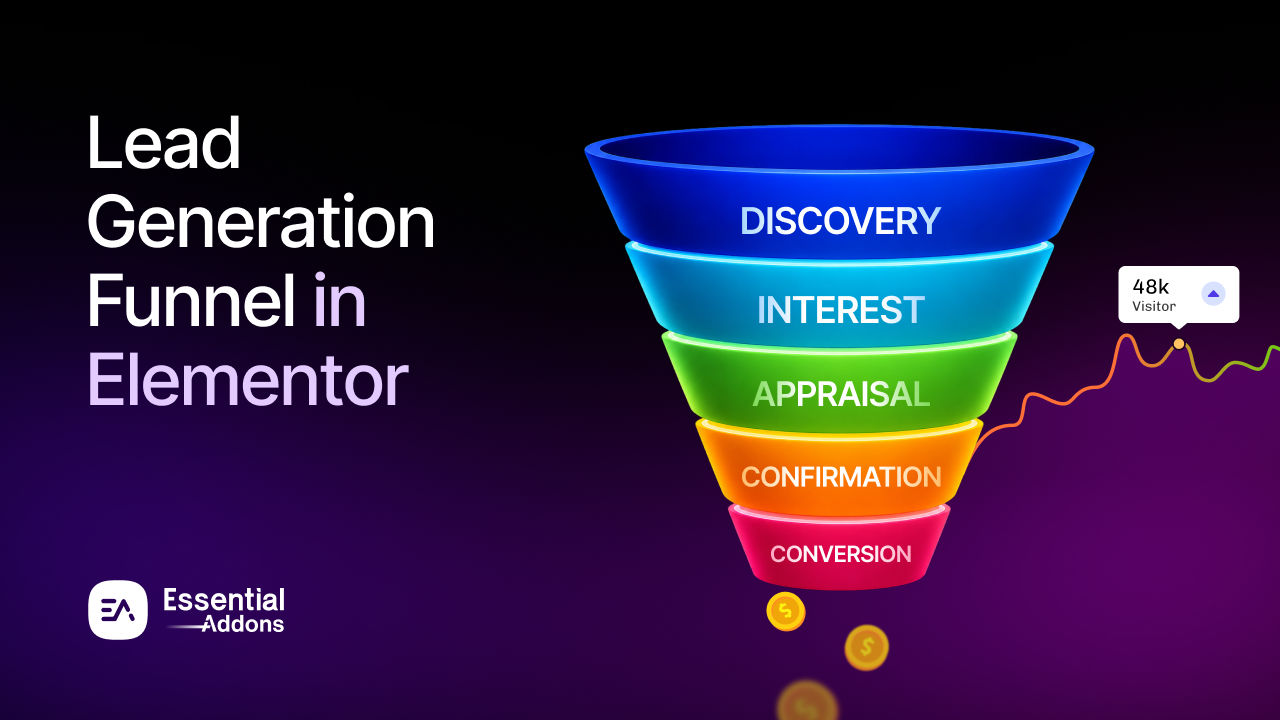
When you break the process into smaller steps, the experience feels easier, more interactive and more intentional. Instead of overwhelming visitors with too many fields at once, you guide them from curiosity to conversion in a structured way. In this guide, you will learn how to plan, build, optimize, and measure a high-converting multi-step funnel in Elementor without making it feel complicated.
TL;DR (Quick Summary)
Too long? Didn’t read? Here is a quick summary of the post.
| Section | Key Takeaway |
| What Is a Lead Generation Funnel? | A lead generation funnel guides visitors from awareness to conversion through a structured journey. |
| Why Multi-Step Funnels Convert Better | Multi-step funnels reduce friction, improve engagement, and increase completion rates. |
| Essential Funnel Components | A high-converting funnel needs a landing page, multi-step form, qualification questions, thank you page, and follow-up. |
| Planning Your Funnel | Clear goals, audience targeting, and step-by-step information mapping lead to better performance. |
| Building in Elementor | Elementor makes it easy to visually create landing pages, multi-step forms and conversion paths without coding. |
| Optimization Tips | Progress bars, analytics, personalization, mobile optimization, and A/B testing help improve results. |
| B2B Best Practices | Focus on lead quality, strategic qualification, sales alignment, and post-conversion nurturing. |
| Measuring Success | Track conversion rate, completion rate, qualified leads, cost per lead, and sales outcomes. |
What Is a Lead Generation Funnel?
A lead generation funnel is the path a visitor follows from first discovering your offer to finally sharing their contact details or booking a next step. A multi-step form is only one part of a lead generation funnel.
It is a structured journey that combines messaging, trust, qualification and action. When built correctly, it helps you attract the right people while filtering out low-intent traffic. In Elementor, this process becomes easier to design visually because you can control the landing page, form experience, and post-submission flow within a single ecosystem.
Understanding the Lead Generation Funnel Process
A lead generation funnel usually moves through four stages: awareness, interest, consideration and conversion. In the awareness stage, the visitor discovers your brand through ads, search, social media, or referrals. In the interest stage, they begin exploring whether your solution matches their problem.
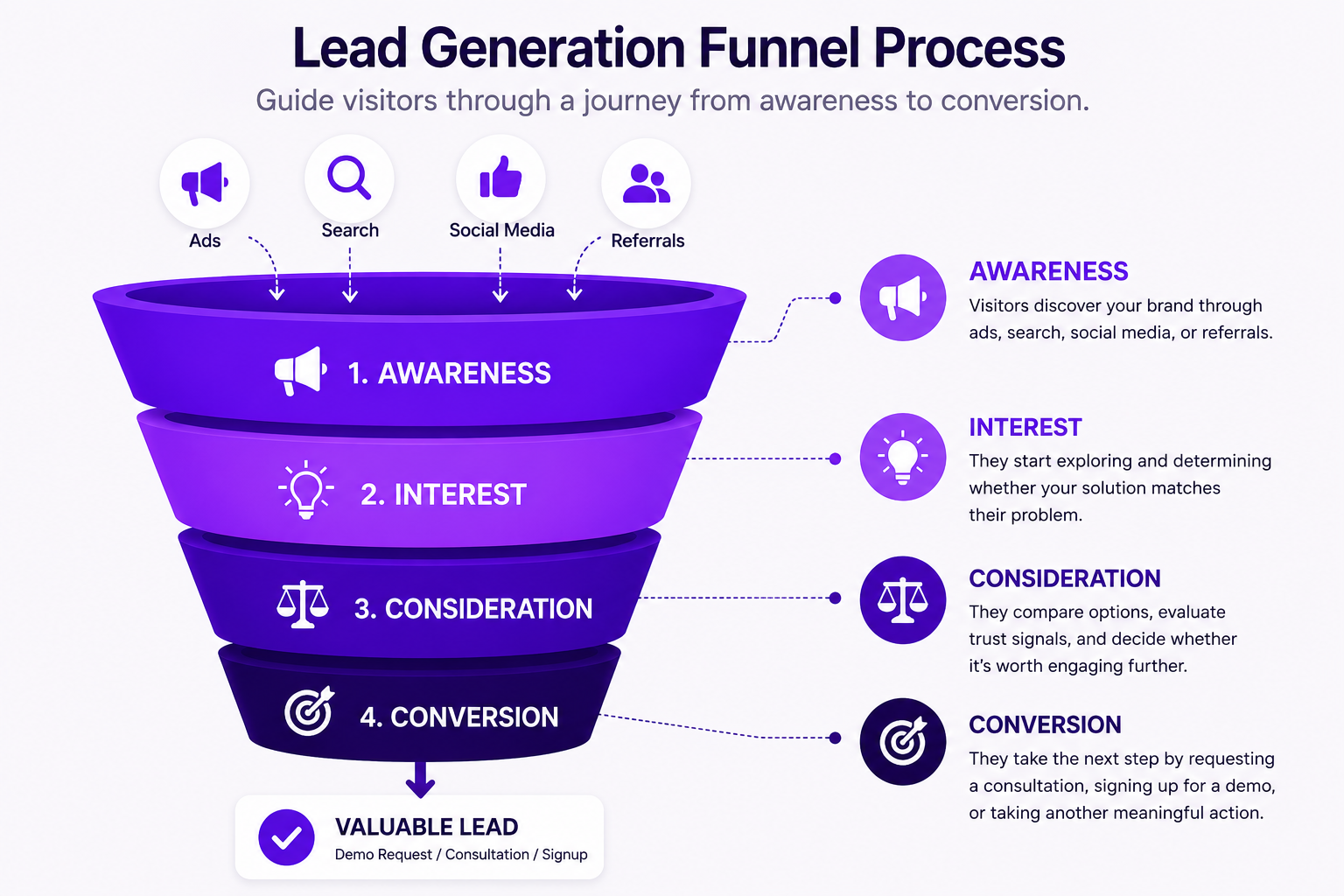
During consideration, they compare options, evaluate trust signals, and decide whether it is worth engaging further. Conversion happens when they complete the funnel by requesting a consultation, signing up for a demo, or taking another meaningful action. A multi-step funnel works well here because it guides visitors forward one decision at a time instead of demanding everything up front.
Why Businesses Need a Lead Generation Sales Funnel
A lead generation sales funnel helps businesses qualify leads before the sales conversation begins. Rather than collecting random inquiries, you gather useful context such as business size, goals, budget, or service needs. That makes your follow-up more relevant and far more efficient.
Funnels also reduce form abandonment because they feel easier to complete. They improve conversion rates by removing friction and building small moments of commitment along the way. On top of that, they create a more personalized journey, making the visitor feel understood rather than processed.
B2B Lead Generation Funnel vs. B2C Funnels
Here is the difference between the B2B lead generation funnel and the B2C lead generation funnel.
| Factor | B2B Lead Generation Funnel | B2C Lead Generation Funnel |
| Sales Cycle | Usually longer and more complex | Usually shorter and faster |
| Decision-Makers | Often involves multiple stakeholders | Usually driven by one buyer or a small household decision |
| Qualification Needs | Requires deeper qualification before sales contact | Often needs a lighter qualification |
| User Intent | Research-driven and solution-focused | Often quicker and more emotion-driven |
| Funnel Content | More educational, trust-focused, and detail-oriented | More direct, benefit-driven, and action-focused |
| Form Strategy | Multi-step forms help collect richer context without overwhelming users | Shorter multi-step or simplified forms often work better |
| Follow-Up | Typically involves nurturing, demos, consultations, or sales calls | Often moves toward immediate offers, sign-ups, or purchases |
The Psychology Behind Multi-Step Funnels
Multi-step funnels can work well because they reduce decision pressure at the beginning of the user journey. A visitor is more likely to take a small first step, such as reading a targeted message or clicking a clear CTA, than commit to a large action immediately. That small interaction builds momentum and makes the next step feel more natural.
This approach also creates a smoother path from curiosity to action. Rather than overwhelming users with too much information at once, a funnel introduces the right message at the right stage. That sequence improves engagement because the user feels guided, not rushed.
Key Benefits of a Multi-Step Lead Generation Funnel
A multi-step lead generation funnel helps businesses create a more intentional conversion journey. It allows you to break the experience into focused stages, where each page or section has a clear purpose. One stage may build awareness, another may introduce the offer, and another may drive the final conversion.
This structure often leads to higher engagement because visitors are not asked to process everything at once. It also improves lead quality by warming users up before they take action. When people convert after moving through a thoughtful funnel, they usually have stronger intent and better context.
Essential Components of a High-Converting Lead Generation Funnel
A successful funnel is a complete system made up of persuasive messaging, smart qualification, post-submission direction and follow-up. Each component has a specific role in moving the visitor toward action. When these pieces work together, your Elementor funnel becomes more than a design asset; it becomes a lead generation engine.
A Compelling Landing Page
Your landing page is where attention turns into intent. It should clearly explain the problem, present your offer, and show why taking action is worthwhile. Strong headlines, concise supporting copy, and one clear call to action are essential.
This is also where trust signals matter. Testimonials, results, client logos, FAQs, and benefit-driven sections help reduce hesitation. If you want to enhance these sections visually, adding extra design flexibility through tools like Essential Addons for Elementor can help you create more polished testimonial areas, content blocks and CTA sections without overcomplicating the layout.
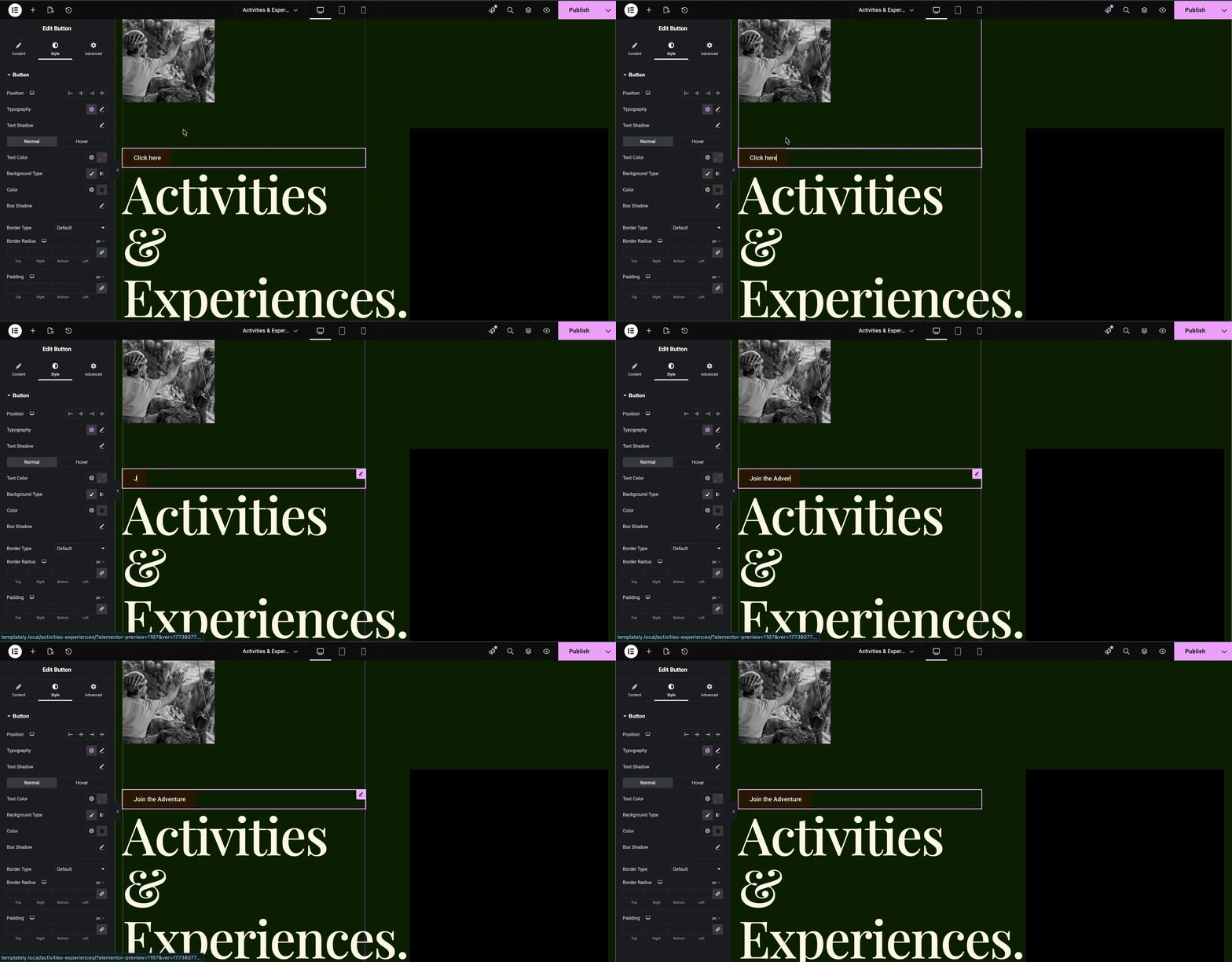
Multi-Step Lead Capture Form
The form is the heart of the funnel. It should guide users through a logical sequence of questions, starting with simple inputs and gradually moving toward more detailed qualifications. The goal is to make the process feel natural rather than transactional.
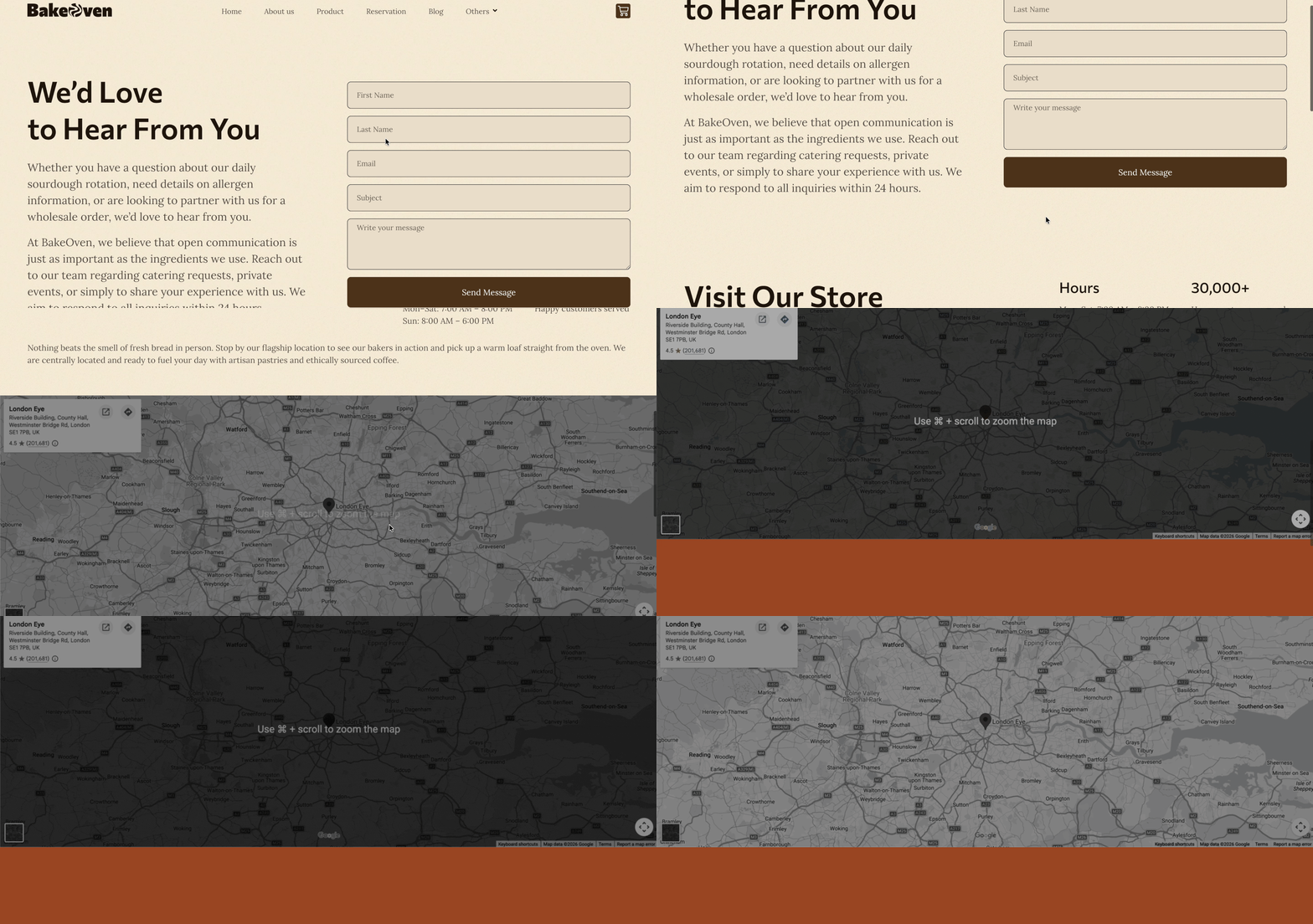
Each step should have a single purpose. For example, the first step may identify the user’s need, the second may qualify the project, and the final step may capture contact information. That structure improves both completion rate and data quality.
Lead Qualification Questions
Qualification questions help separate casual browsers from serious prospects. Instead of only asking for name and business email, you can gather information that makes your sales follow-up more useful. This might include company size, monthly budget, target timeline, service type, or business goals.
The key is to be strategic. Ask questions that help you personalize the next step, not questions that satisfy curiosity. Every field should earn its place by improving either conversion quality or follow-up relevance.
Thank You Page And Next Steps
A thank you page should do more than confirm submission. It should reassure the user that the process worked and guide them toward what comes next. That may mean booking a call, checking their inbox, downloading a resource, or reviewing your process.
This page is also a great place to reinforce trust. A short message about response time, what they can expect and how you typically work can reduce uncertainty and keep the lead warm after they convert.
Email Follow-Up Sequence
Your funnel is not finished when the form is submitted. A fast and relevant follow-up sequence helps turn a lead into an opportunity. The first email should confirm the action, deliver any promised asset and keep momentum going. None of that works if the emails land in spam, so it’s worth running an email deliverability test to confirm your domain is authenticated before your follow-up sequence goes live.
From there, you can nurture based on the user’s responses. If someone selected a specific service or challenge, tailor the messaging to that interest. This is where your funnel starts feeling truly personalized and where better qualification starts paying off.
Planning Your Funnel Before Building It
Before building anything in Elementor, it is important to plan the funnel as a complete journey. A high-converting lead generation funnel is not just a landing page with a CTA. It is a sequence of stages designed to move the right audience from first interest to final conversion. When you plan around funnel stages instead of isolated elements, your messaging becomes clearer, your pages become more purposeful, and your conversions become easier to optimize.
Define Your Funnel Goal
Start by identifying what the funnel is meant to achieve. Some funnels are designed to generate consultation requests, while others aim to book demos, collect qualified inquiries, or drive downloads that lead into nurturing. A clear goal gives direction to every stage that follows.
When the end goal is well defined, it becomes easier to decide what each part of the funnel should do. Your landing page, CTA, page flow and follow-up sequence should all support that one conversion objective instead of pulling the visitor in different directions.
Identify Your Ideal Audience
Before writing the copy, define who the funnel is for. Different audiences respond to different pain points, language and offers. A SaaS founder, a local service business owner and an eCommerce manager will not all move through the same funnel in the same way.

When you know your audience well, you can align the page with their expectations. That means better headlines, stronger offers and more relevant qualification questions. It also helps you avoid unnecessary steps that do not add value for that specific user.
Map the Funnel Stages Around User Intent
Every stage of the funnel should match the visitor’s level of awareness and readiness. At the top of the funnel, users may need problem-focused messaging and educational content. In the middle, they need stronger differentiation, trust signals and a clearer understanding of your offer. At the bottom, they need a compelling reason to take the next step now.
Planning around intent helps you avoid jumping too quickly into conversion mode. It ensures that each step earns the next one, which makes the overall funnel feel more natural and persuasive.
Plan the Landing Pages for Each Funnel Stage
Instead of thinking only about one page, think about how each landing page supports a stage in the journey. Your first page may focus on attention and problem awareness, while the next may introduce your solution in more detail. Another page may be designed specifically for conversion, where distractions are reduced and the CTA becomes more direct.
This page-by-page planning makes the funnel easier to build and easier to optimize later. Each landing page has a specific purpose, which helps you improve performance without changing the entire journey at once.
Decide What Information to Collect at Each Step
Not every question belongs on the first screen. Break the stages based on effort and importance. Start with quick selections or simple multiple-choice answers, then move into deeper qualification and finally ask for contact details.
This sequencing matters because it builds momentum. Visitors are more likely to share personal information after they have already answered a few easy questions. It also makes the interaction feel more conversational and less demanding.
Plan the Follow-Up Journey After Conversion
The funnel should not end at the point of submission or signup. Planning what happens after conversion is just as important as building the pages before it. Some users may need a thank you page with scheduling options, while others may need an email sequence that nurtures them toward a later decision.
When follow-up is built into the funnel strategy from the beginning, the whole system feels more complete. It also increases the value of every lead because you are creating a path for continued engagement rather than stopping at the initial conversion.
Why Elementor Works Well for Building Lead-Generation Funnels
Elementor is a strong choice for building a lead generation funnel because it gives you visual control over every part of the journey. Instead of piecing together separate systems for landing pages, conversion sections, and post-click experiences, you can design the funnel in one flexible environment. That makes it easier to keep the experience consistent from the first interaction to the final conversion.
Makes Funnel Building More Visual And Strategic
One of Elementor’s biggest strengths is that it lets you build pages based on funnel goals, not just layout preferences. You can create stage-specific landing pages, shape content flow around user intent, and place CTAs exactly where they make the most sense. This makes it easier to design with conversion in mind instead of simply filling pages with content.
Supports High-Converting Landing Pages Without Code
Lead generation funnels rely heavily on landing pages and Elementor is especially effective here. You can build focused pages with clear headlines, trust-building sections, benefit-driven content blocks and strong calls to action without custom coding. This gives you more freedom to tailor each page to a specific stage of the funnel.
Works Well for Multi-Step Funnel Journeys
A funnel usually involves more than one screen or interaction point, and Elementor makes it easier to connect those experiences. You can create separate landing pages for awareness, consideration and conversion, or design a long-form page that moves users through those stages in a controlled flow.
Gives You Room to Scale And Optimize
As your funnel evolves, Elementor gives you room to improve it without rebuilding everything from scratch. You can test headlines, restructure sections, create dedicated campaign pages, and refine conversion paths as your strategy matures. That makes it easier to optimize performance over time instead of treating the funnel as a one-time build.
How to Build a Multi-Step Lead Generation Funnel in Elementor (Step-by-Step)
Now comes the practical part. Once your strategy is clear, Elementor gives you the visual control to bring the funnel to life. The key is to build with conversion in mind, not just aesthetics. Every section, field, and action should help move the visitor forward with less friction and more confidence.
Step 1: Create a Dedicated Funnel Landing Page
Begin with a dedicated landing page instead of sending traffic to a general homepage. Your funnel page should have one focused objective and minimal distractions. Remove unnecessary navigation if possible, tighten the messaging and keep the user centered on the next action.
Use a strong headline that addresses the visitor’s problem or desired outcome. Add a short benefits section, social proof and a clear CTA. If the page feels too generic, conversions will suffer.
Step 2: Build an Interest Stage to Introduce the Offer
Once you have attention, the next stage should deepen interest. This is where you explain the value of your solution, service, or lead magnet in more detail. You can use sections that highlight benefits, outcomes, unique advantages and the specific problem your offer solves.
This stage is also where trust begins to matter more. Testimonials, proof points, results and brand credibility can help move visitors from passive browsing into active consideration. In Elementor, these sections can be structured cleanly so the page continues to feel focused and easy to follow.
Step 3: Create a Consideration Stage
At the consideration stage, users are deciding whether your offer is worth acting on. This is the point where you should answer objections, clarify what happens next and make the value exchange feel worthwhile. Depending on the funnel, this may be the stage where users review details before clicking through to a conversion page or starting a lead capture process.
The goal here is not to crowd the page with too much information. Instead, it is to remove uncertainty and help the visitor feel confident about taking the next step. A strong consideration stage often has more impact than simply shortening a form.
Step 4: Design a Conversion-Focused Landing Section or Page
Now that the visitor understands the offer, the conversion stage should feel direct and low-friction. This is where you place the main action, whether that means requesting a demo, booking a consultation, downloading a resource, or submitting an inquiry. The surrounding content should support that action without distracting from it.
This stage can include a form, but the focus should remain on the overall conversion experience. Strong CTA copy, concise supporting text, trust elements and a clean layout all help improve completion rates.
Step 5: Create a Thank You Page That Moves the Journey Forward
A good funnel does not stop at the moment of conversion. After the user completes the action, send them to a thank you page that confirms the step and guides them toward what happens next. This might include booking a call, checking their inbox, reviewing next steps, or exploring a relevant resource.
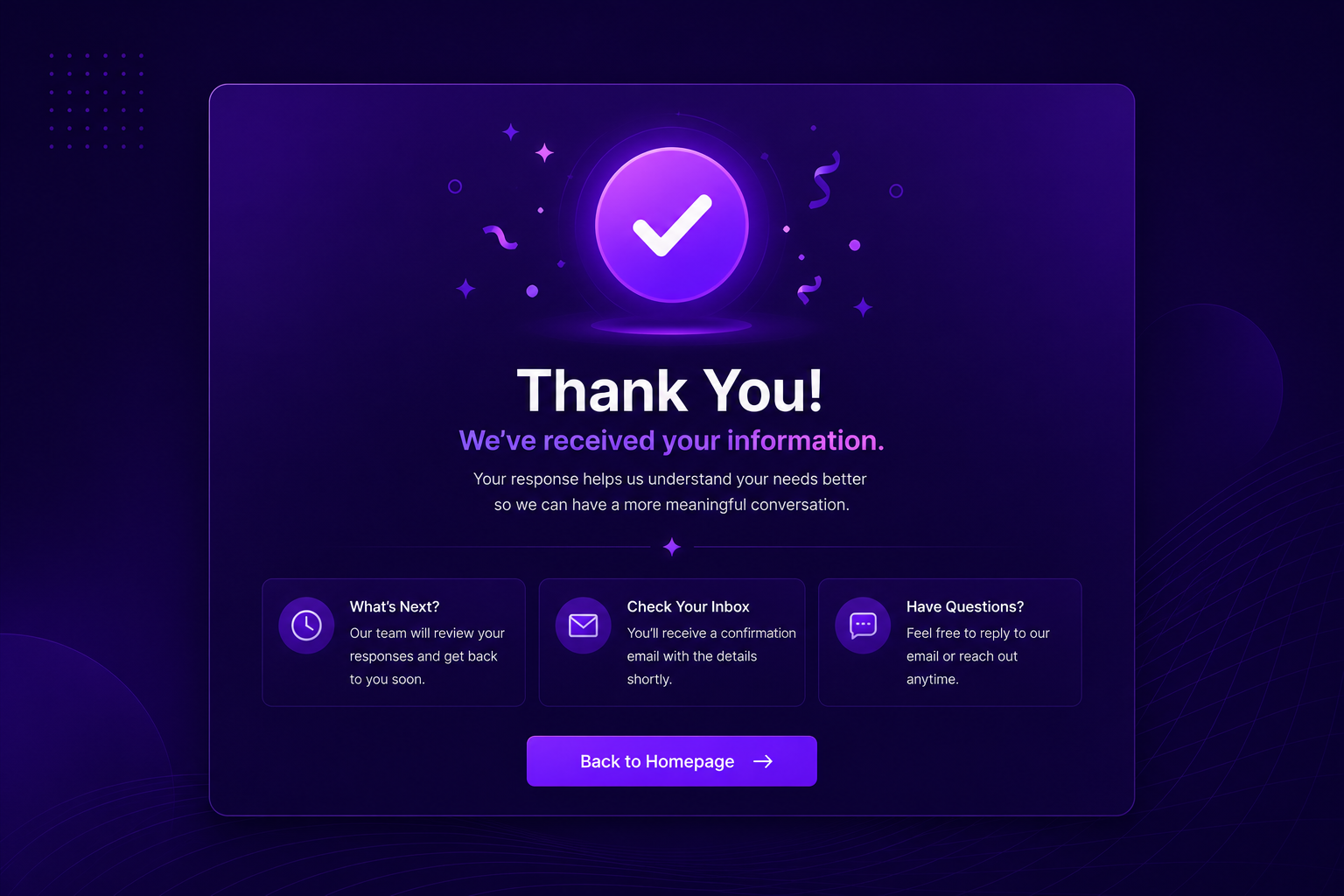
This page is important because it maintains momentum. It also helps reduce uncertainty by clearly explaining the follow-up process, which can improve trust and keep the lead engaged after conversion.
Step 6: Configure Form Actions And Lead Collection
Once the form structure is ready, connect it to your lead collection system. Set up email notifications, CRM integrations, autoresponders, or marketing automation tools based on your workflow. Make sure field names are mapped properly so the data stays organized after submission.
This step is often overlooked, but it matters just as much as design. A beautiful funnel is wasted if leads land in the wrong place or if your team cannot easily act on the information collected. Test everything before publishing so you know submissions, notifications and tags are working correctly.
Advanced Optimization Tips for Better Funnel Performance
Once your funnel is live, the next step is improving how each stage performs. Optimization should not focus only on the final conversion point. A lead generation funnel performs best when you strengthen the full journey, from the first landing page visit to the post-conversion follow-up. Looking at the funnel stage by stage helps you find where attention drops, where trust weakens, and where users need more clarity to continue.
Optimize the Awareness Stage for Relevance
If the first landing page does not immediately connect with the visitor’s problem, the rest of the funnel will not matter. The awareness stage should be optimized around message clarity, audience relevance and a strong first impression. Test different headlines, positioning angles and opening sections to see what keeps users engaged.
This stage is especially important because it determines whether users move deeper into the funnel or leave before any real interaction happens. Often, improving top-of-funnel clarity creates a bigger lift than tweaking bottom-of-funnel elements.
Add Progress Bars And Micro-Interactions
A progress bar reassures users that the process is manageable. It creates a visible sense of movement, which reduces uncertainty and encourages completion. Even a simple step counter can make the form feel more user-friendly.
Micro-interactions also help. Subtle animations, hover states, or field confirmations can make the form feel smoother and more responsive. The key is to keep them helpful, not distracting.
Strengthen the Interest Stage
When users continue past the first stage, they need stronger reasons to stay engaged. This is where you should optimize the parts of the funnel that explain the offer, benefits and expected outcome. If visitors are clicking but not progressing, your value communication may need to be clearer or more specific.
Test how you present the solution, the order of your benefit sections and the way your CTA connects to the offer. Sometimes, a better content flow improves funnel performance more than any technical adjustment.
Reduce Friction in the Consideration Stage
The consideration stage is where hesitation often appears. Users may be interested, but they still need reassurance before taking action. This is why objection handling, proof elements and CTA support matter so much in the middle or lower stages of the funnel.
Look closely at whether users are getting enough confidence to move forward. If not, refine your testimonials, case study references, process explanation, or trust-building content. A smoother consideration stage usually leads to stronger conversion intent.
Use Multi-Step Form Analytics
You should track more than just total submissions. Monitor where users drop off, how long they spend on each step and which fields cause friction. This information shows you what needs improvement instead of leaving you to guess.
Analytics can reveal surprising problems. Maybe your first step is strong, but the second step is too complex. Maybe mobile users abandon at a much higher rate. Once you know where the friction lives, optimization becomes far more effective.
Optimize for Mobile Users
A huge percentage of traffic will view your funnel on mobile devices, so mobile usability cannot be treated as an afterthought. Keep fields easy to tap, reduce typing where possible, and avoid cramped layouts. Buttons should be clear and large enough to interact with comfortably.
Spacing, font size, and field order matter even more on smaller screens. If the mobile experience feels frustrating, your funnel will lose conversions regardless of how strong the offer is.
A/B Test Funnel Variations
A/B testing helps you improve performance with evidence instead of assumptions. Test different headlines, CTA copy, step order, form length, or button text. Even small wording changes can shift conversion rates meaningfully.
Start with one variable at a time so the results stay clear. Over time, these small improvements compound. A funnel that converts slightly better each month becomes a much stronger acquisition asset over the long run.
Best Practices for B2B Lead Generation Funnels
B2B funnels require a more strategic balance between conversion volume and lead quality. You want enough information to help the sales process, but not so much that qualified prospects drop off before submitting. The best B2B funnels respect the user’s time while still gathering the context needed for a serious business conversation.
Focus on Lead Quality Over Quantity
More leads do not always mean better results. If your leads are too broad, you may increase submission count while lowering sales efficiency. High-quality leads are usually more valuable than a large batch of weak inquiries.
That means your funnel should attract the right audience and filter effectively. The goal is not just more submissions. The goal is better-fit opportunities.
Ask Qualification Questions Strategically
Every B2B question should serve a purpose. Ask about factors that genuinely influence fit, urgency, or sales readiness. If a question will not change how you follow up, it may not need to be included.
A good rule is to sequence qualification naturally. Start broad, move toward relevance and only ask for more specific details once the user has already engaged. This keeps the experience smooth while still collecting meaningful information.
Align Funnel Stages with the Sales Process
Your funnel should match how your business actually sells. If your team needs to understand project scope before scheduling a call, build the form around that need. If your process begins with a free audit or discovery session, make that the offer at the center of the landing page.
When funnel stages align with the real sales journey, leads feel better prepared and internal follow-up becomes more efficient. That alignment often improves both conversion rates and close rates.
Nurture Leads After Conversion
Not every lead is ready to buy immediately. Some need time, education, and proof before taking the next step. That is why follow-up matters so much in B2B funnels. A well-timed sequence can keep your brand top of mind and move the lead toward a decision.
This is also another area where your funnel content can work harder. If your landing page and follow-up emails reuse consistent messaging, the overall journey feels more cohesive and trustworthy.
Common Multi-Step Funnel Mistakes to Avoid
Even strong offers can underperform when the funnel is poorly structured. Many conversion problems come from avoidable mistakes rather than weak demand. The good news is that once you know what to watch for, these issues are usually fixable. A clean funnel is often less about adding more and more and more about removing friction.
Overloading the Landing Page
One common mistake is trying to fit too much information onto the landing page before the user even takes the first step. When a page becomes cluttered with excessive copy, too many offers, or too many competing sections, visitors lose focus quickly. Instead of guiding them forward, the page creates confusion and slows down momentum.
A strong landing page should do one main job: help the visitor understand the problem, see the value of the offer and feel motivated to continue. The goal is not to say everything at once. It is to create enough clarity and trust for the user to take the next step in the funnel.
Asking for Sensitive Information Too Early
Visitors are cautious when they first land on your page. If you ask for phone numbers, budgets, or detailed business data immediately, you may create resistance before trust is established. Start with easier questions and build toward more personal information later.
This sequence respects user psychology. People are more willing to share sensitive details after they understand the value of continuing.
Ignoring Mobile Experience
A funnel that looks polished on desktop but feels clumsy on mobile will leak conversions fast. Many businesses focus on design aesthetics and forget practical usability. If the fields are cramped, buttons are hard to tap, or progress feels confusing, mobile users will leave.
Always review and test the entire flow on real devices. Small mobile adjustments often deliver outsized conversion gains.
Failing to Follow Up with Leads
If a lead submits the form and hears nothing back quickly, momentum disappears. Slow or generic follow-up can waste qualified interest that your funnel worked hard to generate. Every submission should trigger a clear next step.
Even a simple confirmation plus a personalized reply framework can improve results. The faster and more relevant the follow-up, the stronger the funnel performs.
Not Tracking Funnel Performance
Without tracking, you are operating on guesswork. You may know how many leads came in, but not why users dropped off or which step needs improvement. That makes scaling difficult.
Measure the funnel regularly so you can identify weak points early. The data will show you whether the issue is the landing page, the form sequence, the CTA, or the follow-up process.
Measuring the Success of Your Lead Generation Funnel
A funnel should be measured by both conversion performance and lead quality. Raw submission numbers only tell part of the story. What really matters is how efficiently the funnel turns traffic into qualified opportunities. Clear measurement helps you improve what is working and fix what is not.
Key Metrics to Track
Start with the landing page conversion rate to understand how effectively the page moves visitors into the funnel. Then track the form completion rate to see how many users finish after starting. These two numbers alone can tell you a lot about page clarity and form friction.
You should also track qualified lead rate, cost per lead and eventual sales conversion rate. If possible, connect form responses to downstream outcomes so you can identify which traffic sources and funnel paths produce the best customers, not just the most submissions.
Tools for Funnel Tracking And Analytics
Use analytics tools that help you monitor both page-level and form-level performance. Track events, button clicks, step progression, and drop-off points. Heatmaps and session recordings can also reveal usability issues that numbers alone might miss.
Inside Elementor-based builds, keeping the funnel visually flexible is helpful, but tracking should stay equally strong. The design may attract attention, but the data tells you what actually converts. That balance is what turns a nice-looking funnel into a high-performing one.
Start Building a Smarter Elementor Funnel That Converts More Leads
A multi-step lead generation funnel gives you a smarter way to capture and qualify leads without overwhelming potential customers. Instead of relying on a long, static form, you create a guided experience that feels easier to complete and more relevant to each visitor. That alone can improve engagement, reduce abandonment, and lead to better conversions.
If you are using Elementor, you already have a strong visual foundation for building that experience. With thoughtful planning, strategic questions and ongoing testing, you can create a funnel that not only looks good but consistently drives qualified leads.
Start with a simple three-step funnel, measure where visitors drop off, and improve one section at a time. Small refinements often have a bigger impact on conversions than redesigning the entire funnel.
We hope you have found this blog useful. Don’t forget to subscribe to our blog for the latest updates. And join our Facebook community so that you do not miss any important updates.